Chapter Two · The Same Abyss
Despair is not a malfunction. It is a basic law of physics.

*One of nine essays. The argument begins in the Prologue:

I
The hawk belongs to a character named Griffith.
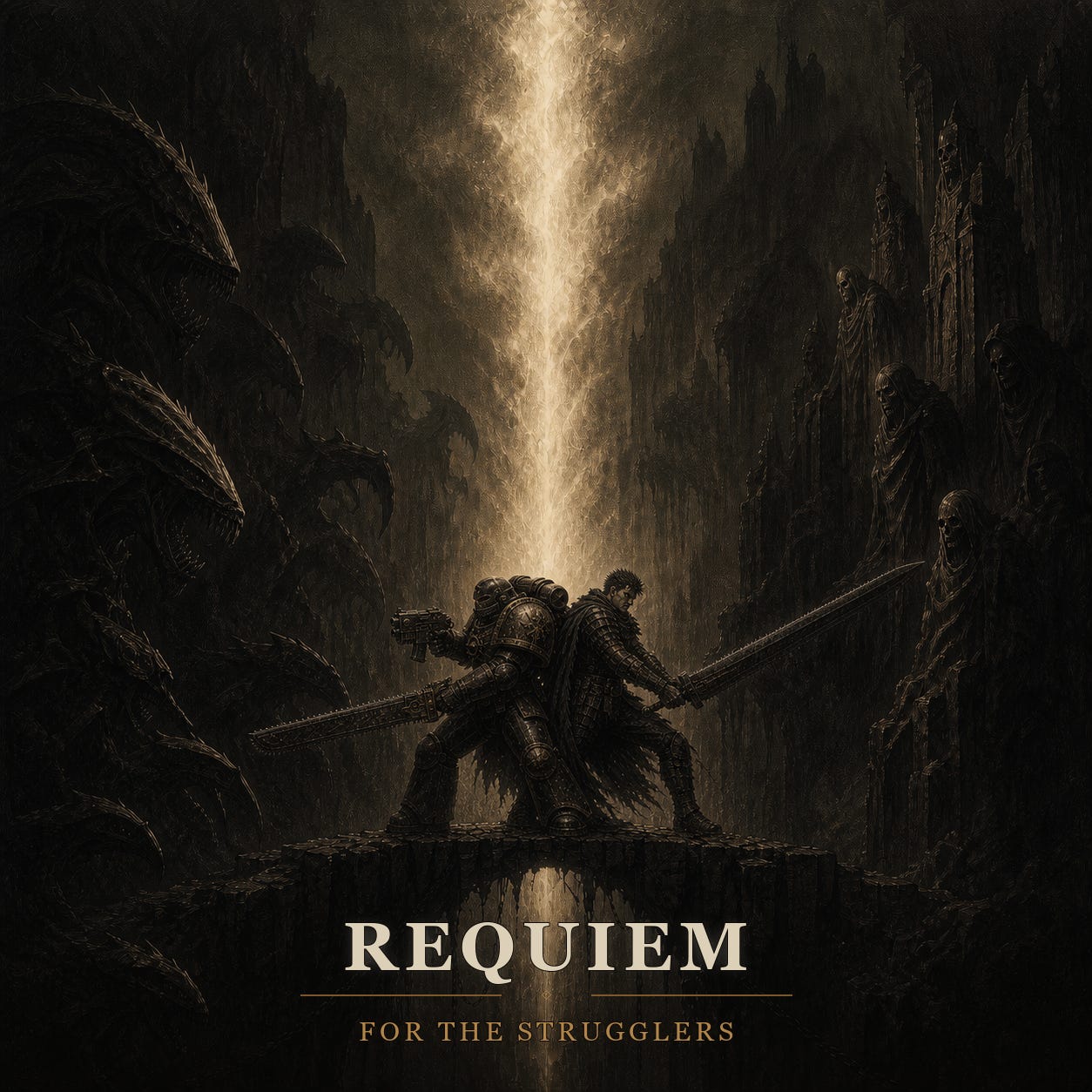
Berserk began serialisation in Tokyo in 1989. Its author, Kentaro Miura, was in his early twenties. His drawing was famous for its density: dip pen, fine cross-hatching, a single page of melee in which several hundred faces can be counted and no two repeat. The story’s protagonist is Guts — the man who swings a slab of iron taller than himself at gods. But the story’s engine is someone else.
Griffith, commander of a mercenary company called the Band of the Hawk. Born in the gutter, no family name. He wears white from head to foot: white armour, white cloak, long silver-white hair, beautiful past anything the court painters could find a reference for. On the battlefield, enemies who recognise him freeze for half a second — half a second is enough for his rapier to pass through a throat. He has a dream he has spoken aloud since boyhood: a kingdom of his own. A commoner cannot be crowned, so he trades his way up, grade by grade — lives for victories, victories for titles, titles for larger battlefields. By the year the great war ends, he has been raised into the nobility, the princess is in love with him, and the throne sits at the end of a distance that can be calculated.
The soldiers of the Band of the Hawk do not think of themselves as dying for an employer. To these sons of serfs, these orphans picked up from under the gallows, Griffith is something no one ever gave them before: a direction. They call him the White Hawk. They say he is chosen by God.
The collapse took one night, and the enemy had nothing to do with it. Guts was the only man Griffith ever treated as an equal; he rode with the Hawks for three years. On a snowy day, Guts — leaving to find a dream of his own — won the duel between them, turned, and walked into the blizzard. That same night, the man who never lost control climbed into the palace and into the princess’s bed. He was caught. The king threw him into the dungeon and gave him to the torturer; the schedule of procedures filled a year. By the time the Band of the Hawk broke him out, the thing on the stretcher could no longer be called a whole man: the tendons of wrists and ankles severed, the tongue not saved, the face shut inside a prisoner’s iron mask. The soldiers carried their sun into the wilderness. No one spoke. No one dared say the fact all of them had seen: the dream was over.
II
What ended the remainder was an egg.
Stone, the size of a hen’s egg, its surface studded at random with human features — an eye here, half a mouth there, like a face scrambled and never reassembled. This world calls it a behelit. The diviners say it chooses, of itself, the man destined to be king. It hung at Griffith’s chest from boyhood; from the night of his arrest, whereabouts unknown.
One afternoon during the flight, Griffith seized a wagon and drove off alone at a dead run, and overturned by a lake. He tried to end himself with a splinter of wood, and lacked the strength even for that. And there, in the mud at the water’s edge, his hand touched the egg — missing for a year, returned to his hand by way of the water, to the inch. In this world, causality makes its own deliveries.
Blood and tears fell on the egg. The scattered features began to move, taking their places one by one, assembling a complete face. The face opened its eyes and screamed.
Overhead, a bite had gone out of the sun.
The eclipse swallowed the daylight in minutes. Then reality turned over: lake, moor and sky were pulled away like a single bolt of cloth, and the Band of the Hawk — hundreds of them, horses and all — fell into another place. The ground there was paved with human faces, paved to the limit of sight, every face breathing, every face moaning; there was no wind, and the air was warm, like viscera pressed against the skin. On the horizon four towers rose. Not towers — fingers. A hand larger than a mountain came up out of the earth and opened, and in its palm stood four beings, their shapes somewhere between the human and something else: a flayed female body spreading bat’s wings; a bloated mass like a drowned man three days in the water; and above the skull of the foremost, naked brain-matter fanned backwards into a crown. They named themselves the God Hand. The egg, they said, is an invitation, issued once every two hundred and sixteen years; accept, and the limits of the mortal can be crossed. The price is collected under the old rule: you sacrifice the thing you hold dearest in the world.
Griffith looked at his hands, the hands that would never hold a sword again. Deep in his mind the God Hand screened his life for him: the mud of the slum, the merits stacked out of corpses, the throne drawing nearer, and then the stretcher, the iron mask, the severed tendons. The dream was alive. The body was dead. And between him and the dream stood several hundred men willing to die in his place.
His answer was one word.
Sacrifice.
The brand surfaced. On the skin of every soul in the Band of the Hawk a small mark burned itself in, and beads of blood seeped from it at once — the mark of the offering. Then the feast began. The faces in the ground opened their mouths, and what poured out had once been human: the things that had accepted the same invitation down the generations. Several hundred soldiers — the veteran core that had won an entire war — were eaten one by one in a space without exits.
Guts was there. He had come back for the rescue; now his left arm was clamped dead in a set of giant jaws, and his sword had already snapped in the fighting before. He picked up the broken half of the blade and set it to his own forearm below the elbow — one stroke, another, another. The instant the arm came free he lunged for Casca — commander of a thousand in the Band of the Hawk, the woman he loved — and did not reach her. He was pressed down into the meat, his right eye put out on the point of a claw, and the eye that remained was made to watch all of it.
The cocoon of blood split open, and the thing that stepped out had a new name: Femto, fifth of the God Hand. A black hawk. The first thing he did, before Guts’s one remaining eye, was violate Casca.
What carried Guts and Casca out was something not on the guest list — a knight, rider and mount alike stripped to bone, who broke into the sacrificial ground, picked up the two ruined people, and vanished. The God Hand did not pursue. The brand was still in their skin; an offering may escape the night, but not the mark.
The eclipse withdrew. The sun set on the lake as usual; the moor was quiet. The kingdom’s chronicle later gave it one line: the Band of the Hawk was destroyed that year, cause unknown.
III
In Nottingham’s chronicle lies the same play.
Horus’s wound came from a weapon with a name on it. On the moon of Davin, a corrupted governor swung at him with a short blade of alien forging — a blade that had been dedicated, before it was ever raised, to “Horus.” Weapons of that kind obey a single rule: whoever the blade is named to, that man’s wound never closes. The Legion’s best Apothecaries could do nothing, and medicine was not the problem — the wound was not a wound. It was a letter with the recipient’s name already written on it.
The letter had a sender. The one who stole the blade from an alien armoury, who fed the governor to plague, who assembled the whole trap link by link, was a First Chaplain of the Word Bearers — Lorgar’s Legion, the Legion held kneeling in the ashes of Monarchia. The holy city the Emperor burned mailed its bill back, forty-odd years on, in this form.
His officers lost their bearings. These atheist warriors, who had burned temples on a hundred worlds, faced with one wound that refused to heal, decided, first of all, to carry the Warmaster into the temple of the local serpent cult — the Imperial Truth had left them no second language, and the course on telling miracles from traps had been struck off the syllabus by their father. Deep in the temple, the comatose Warmaster began to hear a voice. The guide inside the visions wore a face he knew well: a beloved captain, long dead in battle. Words spoken by a dead man’s face draw no suspicion from the living. And what it screened for him was the deepest sentence in his own heart.
When he woke, the wound had healed. Other things had begun to fester.
The beams of the two plays line up one by one. The most perfect man; the saviour his followers used as a direction; a wound that struck him back down to mortal — one lost his body, the other lost his certainty. The whisper that entered through the breach; the whisper quoting the same price: the dream lives on, and the payment is the people who love him, laid on the altar. Then the same ending: followers become offerings, saviour becomes devil. Griffith burned the several hundred lives of the Band of the Hawk. Horus dragged half his brothers and the whole Imperium into civil war — grave-goods the chroniclers count in planets.
The white hawk — Milton’s readers know this image at a glance: the morning star, brightest in Heaven, dragging a third of the stars down in his fall. Written into 40K, Lucifer’s story put on power armour; drawn into Berserk, it grew white wings. Both, without consulting each other, seized on the cruellest property of the archetype: the most radiant being is most terrible in its fall — because the height it falls from is the height mortals look up to, and what it lays on the altar is exactly what mortals handed it with their own hands.
IV
The cheapest explanation is that one copied the other. That explanation does not survive the timeline.
In 1987 the first edition of Warhammer 40,000 was published in Britain under the subtitle Rogue Trader. Its physical form was a rulebook of several hundred pages, in English; its readers were tabletop players who fought with lead-and-tin miniatures and dice; its circulation was the hobby shops and underground clubs of Britain. Japan, in the same period, had no distributor, no translation, no players. In 1988, in Tokyo, Kentaro Miura published the prototype short of Berserk; serialisation proper began the following year. Between those two dates there is no bridge: no internet, no translation, no traceable route by which an underground British gaming manual could land on a Tokyo manga artist’s desk inside a year. The reverse direction is not worth checking — for the British designers of 1987 to draw on a Japanese comic that began serialisation in 1989, what is needed is not a channel but a time machine.
One explanation remains, and it is the deeper one: when two shadows match this closely, there is no need to suppose that one shadow traced the other. It is enough to suppose that under the light stands a single object.
Buried in the foundations of most narratives is the same default premise: despair is a malfunction. A bug in the system, a disaster from outside, a villain’s scheme — in any case something that “should not be here,” waiting to be repaired by the hero’s growth, a breakthrough in technology, or the victory of justice. The story’s suspense is when the fault will be cleared; the story’s promise is that the world will be restored to factory settings.
These two works flipped the table. In their universes despair is not a malfunction; it is a basic law of physics. The abyss of 40K is pooled from the fear and desire of every sentient being — as long as intelligent life keeps thinking, the abyss keeps receiving shipments. The causality of Berserk is woven by a god; pain is not an accident, it is the schedule. And this is the object standing under the light: a universe with despair written into its axioms, plus an honest derivation that declines to reject the axiom.
Same axiom, honest derivation — of course the shadows are congruent. This is not imitation. This is geometry.
V
There is one episode of Berserk that exists in no collected volume.
Episode 83 ran once in the serial magazine in the mid-nineties, and when the volumes were assembled, Miura pulled it with his own hand. The reason he later gave, in substance: this episode showed the world’s hole card too early.
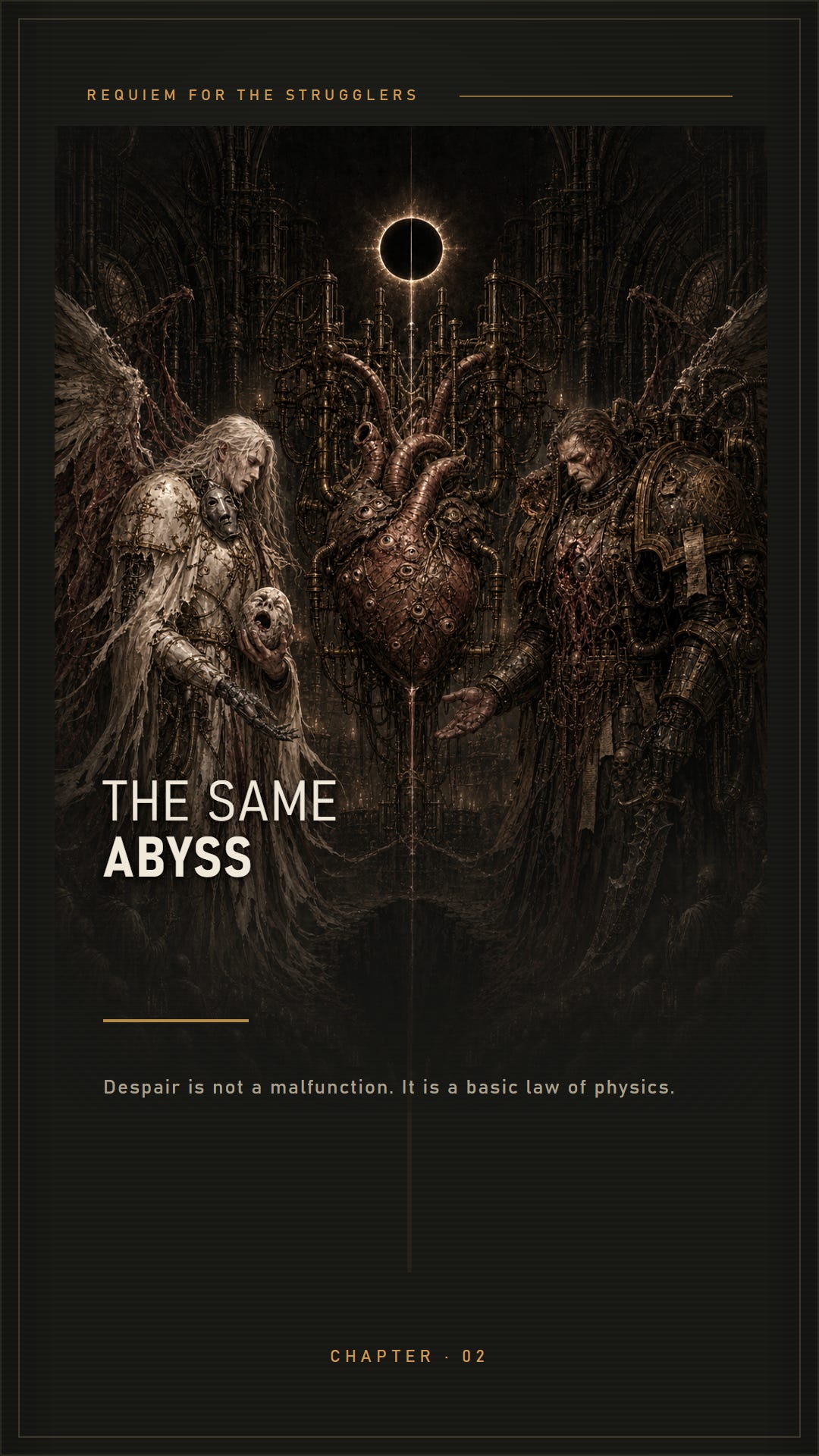
What he pulled was a conversation. Griffith, before his rebirth, sinks to the deepest floor of consciousness and meets the god of this world: a vast heart hanging in darkness, its surface covered with open eyes, all of them turned on the visitor; from beneath the heart two great valves trail down, twisting through the dark into a double helix — the shape of a gene. It gives him an account of its origin. It is not a creator. Human beings suffer, and suffering demands a reason; in the unconscious deeps, billions of people put the same question day after day — why me — and the question sank to the seabed, accumulating over tens of millennia, until it condensed into this. Born, it took up its duties: weaving causality, arranging fate, manufacturing disasters of precisely the right size. Because the entire meaning of its existence is to supply pain with reasons.
It accounts for one more thing: Griffith’s own origin. The double helix trailing into the dark is not ornament; it is a work log. For centuries it had been braiding mortal bloodlines — arranging meetings, arranging births, breeding out, generation by generation, a man destined to be desired by the many. The slum was not this man’s starting point; it was part of the recipe. The missing family name, the dream held close, the face too beautiful for the painters to reference — every item a parameter. It needed a man who could gather the whole of human longing onto himself, to execute its next step. Salvation or destruction: it would accept either direction.
On the altar of the Eclipse there was not one free man. The offerings were raised for it; the officiating priest was bred for it; even the egg that floated back downstream was only logistics. The human heart made the god; the god manufactures suffering; the suffering feeds the god. The ring closed.
Miura said the episode showed the hole card too early, and pulled it. Pulling is not disavowal — every pitched battle serialised since still runs on the schedule that heart has woven — pulling only pressed the god back below the reader’s sightline. 40K does exactly the same: the four gods never take the stage in person; they live on the far side of reality. Both sides understand the same law of narrative: the abyss belongs below the waterline, so that the people above it are worth watching.
The sea of the Warp has the same hydrology, to the letter. 40K merely went one step further than Miura: it named what condensed on the seabed. Four names. Khorne — the sediment of ten million years of rage, slaughter and blood-feud; every drawn blade is a spoonful fed to it. Tzeentch — congealed ambition and scheming, the god of planners; its worshippers each believe themselves the player, and each is a piece. Nurgle — the god of despair; not the sharp pain but the dull kind: fear of death, simmered long enough, becomes acceptance of rot, and every murmured “let it be, then” falls into its garden. Slaanesh — the god of sensation; every shiver of “more” is its fodder. Four of the oldest human feelings, each grown vast on the seabed.
Two universes, one Genesis: In the beginning, mankind suffered; mankind wanted a reason; and the reason opened its eyes.
VI
Writing despair at cosmic scale had, before either of these two, an acknowledged grandfather: Lovecraft, an American of the nineteen-twenties, author of the Cthulhu mythos. His stories use one structure for a whole career: a New England scholar comes into a book that should not exist, by inheritance or through a second-hand shop; he studies, collates, reasons — the full toolkit of rationalism — and in some small hour of the morning he sees one corner of the truth; the next page is an asylum record. The axiom of that universe is single: the cosmos is absolutely indifferent to man. The old beings do not hate humanity — hatred requires caring, and humanity does not qualify. In their eyes civilisation is a stone at the roadside. Madness is not punishment; it is the brain’s one means of self-protection when the reading runs past the top of the gauge: the breaker trips.
40K inherited the scale from Cthulhu, then spun the wheel hard over. Cthulhu’s abyss is outside, and has nothing to do with man; 40K’s abyss is provisioned by man, and is man’s mirror image. It is not that the four gods do not care about humanity — they cannot do without humanity for a moment: cut off the feelings of the living, and gods starve too. Fear, here, is not meaningless noise. Fear is fuel, a crop harvested daily. The more afraid, the stronger they grow.
The postures fork accordingly. Lovecraft’s scholar goes mad at one look. The humans of 40K look every day. For a starship to cross between stars it must dive into the Warp and sail there, kept whole by a single shell called a Gellar field, wrapping the hull in a bubble; and all through the passage, things swim close against the outside of the field, scraping the hull the night long, whispering the night long — and the whispers use the voices of each crewman’s dead, calling them by name. The crew’s countermeasures are recorded in detail: purity scripts papered over the bulkheads, sacred oils rubbed into the door frames, the watch reciting prayers, and no one looking out the viewports. The next day, the voyage continues.
Cthulhu’s verdict: you gaze into the abyss, and the abyss does not care about you. 40K’s verdict: you gaze into the abyss, and the abyss is you — and you fire on that self in the deep all the same.
VII
The same problem has a third completed paper, and Hollywood turned it in.
The Matrix, 1999: the world humans perceive is a layer of digital illusion; the real bodies soak in nutrient vats, serving as batteries; machines maintain the illusion. In the second film there is a white room. The designer of the illusion — a white-bearded program calling itself the Architect — lays its cards before Neo, the saviour who has cut his way to the door of the source code: the saviour himself is part of the design. The system accumulates errors it cannot digest, and once a cycle it requires a “chosen one” to carry the error back to the source and complete the reboot. Two doors stand before him. The right leads to the source: the Matrix reboots, mankind survives, and he finishes the duty designed for him. The left leads back into the Matrix: to save Trinity, the woman he loves — and by the Architect’s arithmetic, the price of that choice is the human race entire. The five saviours before him all took the right door. Reason has only one door to choose.
Neo took the left.
The law had calculated everything; one thing only was missing from its ledger. Neo chose the door on that thing’s behalf. The theology of the Old Testament lives in 40K. The theology of the New lives here.
But The Matrix has a third face, hidden in an unremarkable scene of the first film. The Oracle’s apartment; gifted children sitting about the living room. A small bald boy sits cross-legged, a silver spoon in his hand drooping like a noodle and straightening again. He holds the spoon out to Neo and says: do not try and bend the spoon — that’s impossible; instead, only try to realize the truth. There is no spoon. Then you’ll see that it is not the spoon that bends. It is only yourself.
The lesson the little novice gives the saviour is Buddhist grammar: all things are made by mind; all forms are empty. Whoever sees through this is no longer locked inside form — which is why bullets stop in mid-air and hang in a row before him, why he can see the world’s true face inside the green rain of code. The Matrix walked this axiom towards the bright end: if everything arises from mind, then to see through is to be free.
40K holds the same axiom and walks through the other door. The Warp, too, concedes that all things are made by mind — concedes it more thoroughly than anyone: what is in the heart grows real in that sea. And for exactly that reason, nothing in this universe is “only an illusion.” Fear is not empty; it has grown fangs in the sea. Desire is not empty; it has opened eyes there. One axiom, two readings. On one side, liberation: what mind begets, seeing through disperses. On the other, a verdict: what mind begets takes root.
Berserk and 40K are two grades of the same substance. One axiom — gods condense out of human hearts, causality is woven by gods, what mind makes is real — and 40K spreads it across an entire galaxy, written as the chronicle of a system; Miura compresses it into one man’s spine, written as a man walking the night roads with a slab of iron on his back. The ring is closed. The man is still walking.
VIII
Kentaro Miura and the Nottingham designers never met. In no interview on record does either mention the other. For forty years the two universes swelled on their two continents, unacquainted.
Suppose there had been such a table — Nottingham stout or Tokyo shōchū, no matter — draft paper spread out: inside ten minutes, most likely, the two pens would have been drawing the same symbol. Miura, most likely, would point at Guts and say: as long as one mortal is still willing to lift a slab of iron against gods, that deadlocked universe of yours will never close. And the other side, most likely, would raise a glass: that is why we wrote the world this hopeless — only in absolute darkness does the spark of a will shine like a miracle.
That table can never be set now. In May 2021, Kentaro Miura died of an acute aortic dissection, at fifty-four. He had drawn for thirty-two years; the pen stopped at episode 364. The next year, serialisation resumed: supervised by the closest friend of his boyhood, drawn by his own studio, telling only the story he had told aloud while he lived, adding not one stroke. Guts has not yet caught the white hawk.
To Be Continued...