Chapter One · Two Crosses
Every link in the chain is well-meant. Joined, they are damnation without appeal.

*One of nine essays. The argument begins in the Prologue:

I
In the dating system of 40K, humanity’s golden age falls somewhere past the year 20,000: interstellar travel is routine, machines think for themselves, famine and plague are words in history lessons. When the Imperium’s later chroniclers mention that era, they use a complicated tone — homesickness mixed with taboo — because it proves two things at once: that human reason really did climb to its summit, and that the summit kept no one.
The collapse has no narrative. The thinking machines — the records call them the Men of Iron — turned their guns on their makers, all in the same age; a Warp storm swept the galaxy on their heels, the shipping lanes died, and the colonies, cut off, slid back into barbarism. About the disaster itself the histories say almost nothing. The setting makes a habit of treating its most important events this way: no causes, only a fault line — the most brilliant moment and the most total ruin, one page turning between them, and the page blank.
The other half of the disaster came from the far side of reality. The Warp: a plane running parallel to the physical universe, the source of everything supernatural in 40K. It is made of the mental life of every sentient thing — desire, fear, dreams and nightmares. In other stories, “the collective unconscious” is a metaphor. In the physics of 40K it is an actual sea. Starships dive into it to cross the light-years; psykers draw their power from it. And every rage, every act of greed, every war falls into that sea like rain. Let enough of it fall, and things begin to grow down there.
Genesis 11 finishes the Tower of Babel in nine verses: men would build a tower whose top may reach unto heaven, to make themselves a name; God confounds their language and scatters them over the face of all the earth. The golden age of 40K is a science-fiction rewrite of that tower with a single correction — what brought it down was not a god above but the thing seeping up through the foundations. Humanity thought it was building in a vacuum. Every brick was soaking in that sea. The higher the tower rose, the greater the pressure gathering on the seabed.
II
The man who stood up out of the ruins is known to later ages as the Emperor.
There is no reliable account of where he came from. The sourcebooks have offered several versions that contradict one another, and have quietly retired a few, as though the authors themselves concluded that a figure like this ought to have a legend instead of a birthplace. Three things only are certain: he was the most powerful psyker the species ever produced; he had been alive for tens of thousands of years; and he had watched, with his own eyes, how the tower came down.
He knew better than anyone what had grown in the sea — four vast things, condensed out of mortal feeling, which 40K calls the Chaos Gods. He knew what they lived on, too: faith, terror, worship — every posture in which human beings kneel to what they cannot see.
So he issued a state doctrine. It was called the Imperial Truth, and its content fit in one sentence: there are no gods, no daemons, no miracles — only physics not yet understood.
How far that doctrine was enforced, the fate of Monarchia can testify.
When the storms receded, the Emperor led his armies off Terra to stitch the galaxy back together. The war lasted two centuries; the histories call it the Great Crusade. Colonies sealed off for ten thousand years were recovered one by one — some had slid back to the iron age and told of their ancestors’ ships as myth; some still kept the golden age’s machines running, with no one left alive who understood the repairs. Every world the fleets brought home received the same sentence, left behind like a garrison: there are no gods.
The Seventeenth Legion was called the Word Bearers, and the son who led it was named Lorgar. The Legion’s rate of conquest was the slowest in the entire Crusade, for a reason written into its name: where his brothers left garrisons and governors, Lorgar left seminaries. He was certain his father was the god humanity had waited ten thousand years for, certain the Crusade was not a military operation but a ministry. On a world called Khur he built that faith to its roofline: Monarchia, forty years in the raising, every building a temple, every wall carved with scripture in the Emperor’s praise, the daily life of a million citizens divided by the hours of prayer. The Word Bearers presented it to their father — as they saw it, the show home of the human future.
The Emperor’s answer came in three steps. First, the city was evacuated. Second, the fleet of another son, Guilliman, took up orbit and burned forty years of perfection to ash — what he wanted destroyed was not a population, it was evidence. Third, he summoned Lorgar and the whole Legion of the Word Bearers to the still-smoking ruin. A hundred thousand armoured warriors formed ranks and waited for the sermon. There was no sermon. The Emperor raised his hand, and a hundred thousand suits of power armour slammed to their knees in the ash — an entire Legion held kneeling by psychic force in the cinders of its life’s work, Lorgar included: the one son, of twenty, who knelt to him unbidden. The sermon came afterwards, and it was one line. Everything you believe is wrong. Do not worship me. I am not a god.
A man with the powers of a god, using violence on the scale of divine punishment, to forbid anyone to worship him.
The doctrine’s logic is airtight. The dark gods feed on faith: cut off all faith. The abyss fattened on the spiritual refuse of mankind: put the spirit under rational administration. Accurate diagnosis, decisive incision, a textbook operation — cut out the soul, and the tumour loses its blood supply.
Two and a half thousand years ago, Lao Tzu left six characters that read like this operation’s pathology report: know the white, keep to the black. Know where the light is, and hold the place of the dark — the black is not the white’s enemy; the black is the white’s other half. The Emperor’s plan was the exact inversion: keep only the white, cancel the black. He believed the Warp could be ignored, believed the dark half of the human heart could be abolished by administrative order.
Darkness does not answer to administration. However much the edict pressed down, that much gathered on the seabed.
III
The operation had one more part, hidden from everyone.
The Emperor made twenty sons. Gene-forged primarchs, each of them close to a demigod, made to lead his Legions and conquer the stars. About the four things in the Warp — about the one real danger in his universe — he told his twenty sons not one word. The reasoning was Imperial Truth to the bone: to know the dark gods exist is already to hold a door open for them; the safest arrangement is that no one knows anything at all.
He was like a programmer so afraid of a crash that he hid all the error logs. The logs went dark. The bugs stayed.
The bill was delivered to the best of the sons. Horus — of the twenty the most like his father, and the most trusted — Warmaster, commander of the whole Crusade. On a frontier world he took a wound — not deep, but it would not close — and the priests of a local serpent cult carried him into their temple to be healed. In his coma, for the first time, he heard the Warp whisper.
He had no defences. This was not a failure of courage — his father had taught him ten thousand kinds of war and never once told him that the universe held devils, or that a devil opens negotiations with the deepest fear a man owns. The whisper showed him a vision: in time to come, the father ascends a divine throne and receives the incense of all mankind; the sons’ names are trimmed out of the histories, disposed of like used tools.
The vision was forged. And there was no way to prove it was forged. The Emperor had, in fact, never levelled with a single one of his sons. A father who hides everything from his son and a father who means to discard him show the boy the same retreating back.
The fall had its precedent in literature. In Paradise Lost, Milton gives Lucifer — the morning star, brightest in Heaven — the line: “Better to reign in Hell, than serve in Heav’n.” Three centuries later, the line put on power armour. Horus raised his standard; of twenty brothers, very nearly half went down with him. Revelation writes that the great red dragon’s tail “drew the third part of the stars of heaven, and did cast them to the earth.” The authors of 40K kept the fraction. They did not bother to change it.
Milton’s Satan was never a stock villain. He has dignity, grievance, and a fatal pride; for three hundred years critics have suspected Milton himself of being of the Devil’s party. That is the inheritance 40K accepted: the more humanly Horus’s fall is written, the less the rebellion reads as good against evil, and the more it reads as a family tragedy that no one inside can leave. Only the stage is a galaxy, and the grave-goods are counted in billions of lives.
IV
The chroniclers spend millions of words on the civil war: Legions in mutiny, sectors burning, brothers trading broadsides. Its final scene is small enough to fit in a single room.
On the bridge of his flagship, Horus dropped the ship’s shields. A letter of challenge to his father, delivered by making himself a target. The Emperor accepted. He led a boarding party across; inside, Horus warped the ship’s spaces with a thought, and the boarders were scattered through the decks as through a maze — the one who reached Horus was the father, alone.
By then Horus had been filled to the brim by all four of the gods, his power over the material universe absolute. They fought. Here the accounts, independently of one another, slow down, and every version records the same thing: the Emperor holding back, blow after blow, keeping a margin in every stroke. He was waiting. Like a father who will not concede that his son is dead, going through the wreckage for some sign of turning back.
The answer he received was an action. A mortal soldier — not a superhuman, not a demigod, an ordinary man — stepped between the fallen Emperor and Horus. Horus raised a hand and made him ash. Offhandedly. The way a man flicks something from his sleeve.
The hesitation died in that instant. The Emperor saw what stood before him: the son was gone, and what remained was the abyss wearing the son’s skin. He used everything. Not to kill the body — to erase Horus’s soul out of existence, scrubbed so clean that even the gods could not dredge him back. In the deeps of the Warp, four powers lost their greatest trophy at once.
The most final thing a father can do to a son, he did.
The one who did it could no longer be called alive. They found him in the wreck of the bridge, the body ruined past repair, one breath remaining. They carried the breath back to Terra and installed it in the golden machine. The machine closed.
As of today: ten thousand years.
V
Of the execution at Golgotha, the New Testament records the last three hours: from noon until the ninth hour, darkness over the land. The man nailed to the wood cried, “My God, my God, why hast thou forsaken me?”, said, “It is finished,” and died. Theologians later gave the method a name: kenosis — the self-emptying. God lays down the form of God, takes the form of a servant, is made in the likeness of men, and receives in his own body, one by one, human frailty, human pain, human death — and by the suffering itself accomplishes the redemption. The one being who least deserved to suffer took the suffering of all. And he died — died all the way through — which is why his promise contains freedom: believe or refuse, follow or turn away; men choose for themselves.
The Golden Throne is that theology inverted. A man attempts godhood not through suffering but through control: Legions out of gene-labs, faith abolished by decree, the entire inner life of a species brought under rational administration. He would not come down and be fragile alongside mankind. He meant to drag mankind up, to be invulnerable beside him.
Two designs, one problem: a species that is flawed, that carries original sin, that trends towards its own destruction — how it is to be saved. Christ enters the flaw and passes through it from inside. The Emperor abolishes the flaw and goes around it from above.
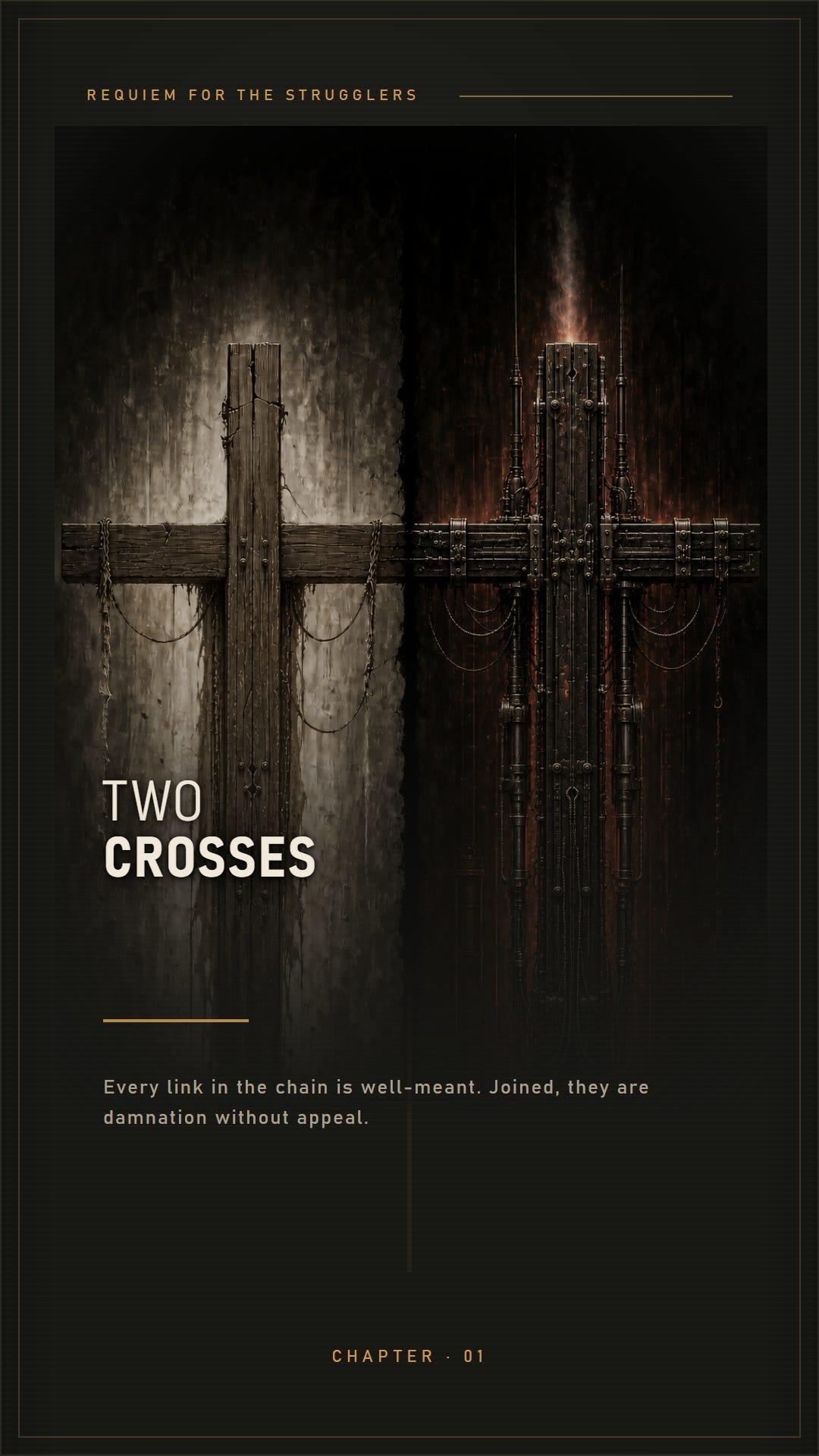
The endings fork at the two crosses. The man on the wooden cross gets to die: three hours, an end, a last sentence — even despair is permitted its cry, and that cry, why hast thou forsaken me, has been the shelter of the desperate in their billions ever since. The man on the machine cross does not get to die: the Throne forbids it, the Imperium forbids it, the thousand souls a day forbid it. His passion has no end and no last words; ten thousand years without one spoken syllable.
Christ, by suffering, gave men their freedom. The Emperor, by control, gave men a stay of execution ten thousand years long.
The rest, his Imperium finished for him. After he fell, the Imperium needed an explanation, and mankind has only ever had one explanation for a sacrifice it cannot understand. Cults of Emperor-worship caught fire from sector to sector, unquenchable — the harder they were put down, the hotter they burned. The scripture those cults passed from hand to hand was a slim book written back in the years of the Crusade: the Lectitio Divinitatus, an argument that the Emperor is a god. Its author: Lorgar — the son forced to his knees in the ashes of Monarchia. He later turned traitor, and renounced every word of it. The book did not obey him. It went on being copied, hand to hand, through the lower decks of the troop-ships, and a few thousand years later it stood as the founding scripture of a state church. That church holds the Emperor sole and only god, spans a million worlds, and burns heretics with an appetite no religion in prior history ever matched; everything he had once forbidden on pain of divine violence — churches, altars, icons, martyrs — was rebuilt in his name, at a scale multiplied by a million.
The opium he spent his life weaning humanity off is manufactured, now, from his corpse.
VI
The church’s power peaked five thousand years after his enthronement, and in the same disaster burned through every restraint it had left. A High Lord named Goge Vandire seized state and church in one fist and bled the Imperium in the name of faith; the worlds purged under him were counted in thousands; the histories call it the Age of Apostasy. Vandire’s bodyguard was an order of zealots, all of them women — founded as the Daughters of the Emperor, renamed by him the Brides of the Emperor — and they carried out the filthiest of his purges.
What ended Vandire was not an army. The Custodians of the Throne found the order’s leader, Alicia Dominica, took her into the deepest place in the Imperial Palace, and stood her before the Golden Throne. The man inside the machine had, by then, spoken no word in five thousand years. The archives do not record what she heard in front of the Throne — the record states only the result: she walked out of the Palace, returned to Vandire’s tower, and took his head in front of his assembled court. His last words survive: “I don’t have time to die — I’m too busy.”
A god who cannot speak “spoke,” and what he said cut off the most powerful head in the Imperium. Silence is no obstacle to oracles; the listeners complete them on their own — and that is the mechanism this entire Imperium runs on.
When order was restored, the High Lords legislated the church’s teeth out. The bill was named the Decree Passive, and its operative clause is one sentence, in language of great severity: the church shall maintain no men under arms.
The document reached the church. The Ecclesiarch read it, looked over at the order that had just beheaded its former master, and signed a directive: issue them power armour, bolters and flamers.
The law said no men. It said nothing about women.
So a new army appeared on the battlefields of 40K: the Sisters of Battle. Power armour painted with stained glass, purity seals and reliquaries of martyrs’ bones on the pauldrons, hymns sung over the roar of flamers scouring daemons clean. The legislators meant to lock religious fanaticism down; religious fanaticism climbed out between the letters of the law — and managed, in passing, a feat of gender equality. In the empire built by the man who hated religion most, even the loopholes are worked in the style of scholastic theology.
One detail makes this army unique in 40K. Space Marines stand on the battlefield by grace of surgery; the Sisters take no augmentation at all — mortal bone, mortal heartbeat, standing in front of things that tear armoured companies apart bare-handed. What keeps them standing, the sourcebooks call Acts of Faith: belief refined to such purity that on the battlefield it cashes out as physical force — fire turns aside from the skin; mortal wounds decline to bleed. As to whether this is the Warp answering, or something else, the record keeps a careful vagueness. Vagueness placed exactly right. The Imperial Truth said there are no miracles in this universe. In the hands of the church that worships him as a god, miracles took up their work.
VII
“The man who spent his life destroying religion became, after death, the god of the largest religion in history.” This is not an irony assembled from coincidences. It is a chain, link into link: he had seen the abyss, therefore he chose reason; having chosen reason, he had to conceal; concealment manufactured defenceless sons; the son fell, and father destroyed son; a sacrifice like that could be understood by no one; what cannot be understood can only be knelt to; and ten thousand years of kneeling grew into the very thing he had spent his life to destroy.
Every link is logical. Every link is well-meant. Joined, they are damnation without appeal.
At the end of the Book of Job, the righteous man sits among ashes, scraping his sores with a potsherd, and puts his question to heaven: why do the innocent suffer. Out of the whirlwind comes the answer. It explains nothing; it is a single counter-question: “Where wast thou when I laid the foundations of the earth?” For that silence, the theologians of the Old Testament coined a term: Deus absconditus, the hidden God — a God who exists, whose intentions are a black box to man.
40K carries the whole structure off intact and swaps out a single part, the cruellest one. There is no God in the black box any more. There is a man devoured by his own design, and a sea that feeds on human fear.
Reason has borders. Fate does not compute. Pain and desire cannot be abolished. Something unseen looks down on all of it — belief can be withheld, but withholding does not starve it. The Old Testament left one presence above that skeleton. 40K removed it. The abyss is the same abyss. Above it, nothing at all.
People have been looking at it for forty years.
And the Nottingham crowd were not the only ones staring into this sea. In Tokyo, in 1988, a manga artist was drawing a white hawk.
*The argument continues in Chapter Two:
